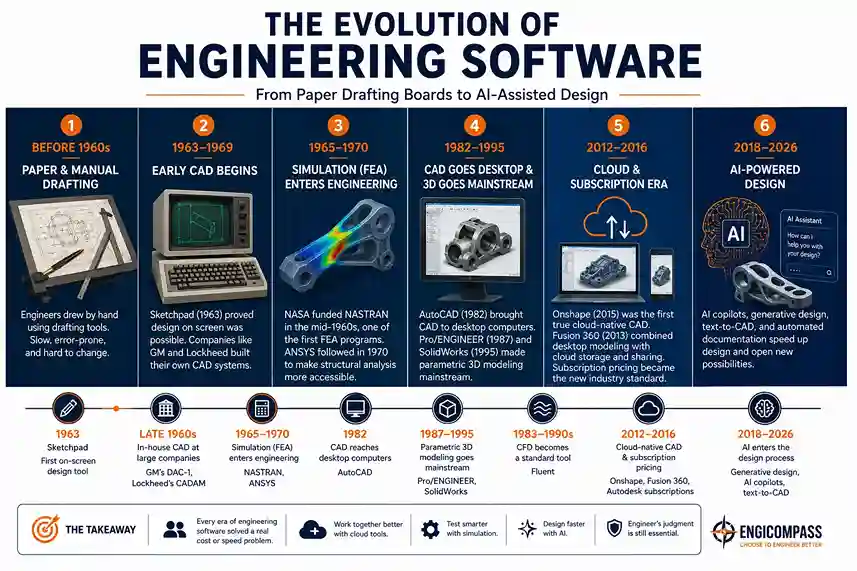
The evolution of engineering software runs from paper drafting boards to AI-assisted design today. In the 1960s, computers took over drafting through early CAD tools. Simulation software followed, to test designs before they were built. Cloud tools then changed how teams buy and share software. Now AI is changing how designs get made — and it matters for what you buy next.
By the Engicompass Team · Last updated: August 2026
How did engineering software start?
Before computers, engineers drew every part by hand. They used drafting boards, T-squares, and slide rules to work out shapes and math. One mistake meant redrawing the whole sheet. This was slow, and it limited how many design options a team could try.
The shift began in 1963, when a student named Ivan Sutherland built a program called Sketchpad at MIT. It let a person draw shapes directly on a screen with a light pen. Sketchpad wasn’t a full CAD system, but it proved computers could handle design work, not just math.
Big companies picked up the idea fast. In the late 1960s, General Motors built its own in-house system, DAC-1, to help design car bodies. Lockheed built a system called CADAM for aircraft parts. These tools were huge and expensive — only companies with mainframe computers could afford them.
By 1969, the first companies selling CAD software to other businesses appeared, including Computervision and Applicon. Still, CAD stayed out of reach for small firms until 1982, when Autodesk released AutoCAD. It ran on a desktop computer, not a mainframe, and cost far less. For the first time, a small engineering firm could afford CAD.
The next big step was parametric modeling — building a 3D model so that when you change one measurement, the rest of the model updates on its own. Pro/ENGINEER (now called PTC Creo) brought this to market in 1987. In 1995, SolidWorks made parametric 3D modeling affordable on a normal Windows PC, and 3D CAD spread far beyond aerospace and car makers — the first major turn in the evolution of engineering software.
How did simulation and CAE join engineering work?
CAD lets you draw a part. CAE — computer-aided engineering — lets you test it before you build it. It checks how a design handles stress, heat, moving air, or shaking, all inside the computer.
This idea is older than CAD itself. In the 1950s and 60s, aerospace engineers needed a way to check if a rocket or aircraft part would hold up without building and breaking real prototypes each time — prototypes were far too costly for that kind of trial and error. NASA helped fund NASTRAN in the mid-1960s, one of the first finite element analysis (FEA) programs. FEA breaks a part into thousands of tiny pieces and works out how each one reacts to a load.
Private companies picked up the idea through the 1970s and 80s. ANSYS started in 1970 to run structural analysis. Fluent, founded in 1983, focused on computational fluid dynamics (CFD) — testing how air or liquid moves around a shape, like airflow over a car or coolant through an engine.
Through the 1990s and 2000s, simulation tools became common well beyond aerospace. Car makers, electronics firms, and consumer product companies all began testing designs on screen before cutting any metal. It was cheaper, faster, and safer than physical testing alone, and it marked the next real turn in the evolution of engineering software.
How did the cloud change engineering software?
For decades, engineering software worked like most desktop programs: you bought it once, installed it on one computer, and saved your files locally. That worked fine when one engineer sat in one office. It broke down once teams spread across cities, countries, and time zones.
Sharing a CAD file by email led to version mix-ups — whose copy was the newest one? Internet speeds also grew fast enough, by the early 2010s, to handle large 3D files without long waits.
Onshape, launched in 2015, was the first true cloud-native CAD tool. The whole program can run in a web browser. There’s nothing to install, and every change saves on its own, much like how Google Docs saves your work as you type. Autodesk’s Fusion 360, launched in 2013, mixed desktop-style modeling with cloud storage and sharing.
Pricing changed alongside the software. In 2016, Autodesk stopped selling AutoCAD as a one-time purchase and moved to a subscription-only model. Instead of a large upfront cost, buyers paid monthly or yearly — a shift that spread across most of the industry within a few years, pushing the evolution of engineering software firmly into the subscription era.
A quick timeline of engineering software
| Era | What changed | Example |
|---|---|---|
| 1963 | First on-screen design tool | Sketchpad |
| Late 1960s | In-house CAD at large companies | GM’s DAC-1, Lockheed’s CADAM |
| 1965–1970 | Simulation (FEA) enters engineering | NASTRAN, ANSYS |
| 1982 | CAD reaches desktop computers | AutoCAD |
| 1987–1995 | Parametric 3D modeling goes mainstream | Pro/ENGINEER, SolidWorks |
| 1983–1990s | CFD becomes a standard tool | Fluent |
| 2012–2016 | Cloud-native CAD and subscription pricing | Onshape, Fusion 360, Autodesk subscriptions |
| 2018–2026 | AI enters the design process | Generative design, AI copilots, text-to-CAD |
What is AI changing in engineering software right now?
AI is the newest chapter in the evolution of engineering software. By 2026, most major CAD platforms have added some form of AI assistant. Onshape has its AI Advisor. Siemens built a Design Copilot into Solid Edge and NX. Autodesk added an AI Assistant across Fusion, AutoCAD, and Revit. Dassault Systèmes built a system called Aura into SolidWorks and the 3DEXPERIENCE platform. Most of these started as chat-style help — asking the software how to do something, instead of digging through a manual.
Generative design has moved further too. Instead of just suggesting a shape based on strength and weight, newer tools also factor in how a part will actually get made — whether it’s milled on a 3-axis or 5-axis machine, cast, or 3D printed. That’s a real shift: a shape that looks “optimal” on paper but can’t be manufactured isn’t much use.
Other tools now handle repetitive documentation work on their own, turning a finished 3D model into 2D drawings, or spotting and labeling standard parts like bolts and fasteners without manual input. A newer category, sometimes called text-to-CAD, lets an engineer describe a part in plain words and get a rough starting model back.
None of this replaces engineering judgment. These tools are fast at repetitive, well-defined tasks — drafting, first-pass shapes, documentation. They are not a substitute for checking tolerances, safety margins, or whether a design can actually be built and certified. Treat AI output the way you’d treat a junior engineer’s first draft: a useful starting point that still needs a careful second look.
What does this history mean for buyers today?
The evolution of engineering software follows one pattern: desktop CAD, simulation, the cloud, now AI — each shift happened because it solved a real cost or speed problem, not because it was new. That’s the right lens for comparing tools today: ask what specific problem a feature solves for your team, not whether it has “AI” in the name.
A few practical takeaways:
- If your team works across offices or countries, a cloud-native tool removes the version-mix-up problem that older desktop CAD never solved.
- If your work involves a lot of repeat or routine geometry, an AI copilot built into your existing CAD platform will usually fit better than a separate AI tool bolted on top.
- Simulation is no longer only for big-budget companies. Many CAD platforms now bundle basic FEA or CFD, so check what’s already included before you buy a separate CAE tool.
- Whatever you pick, review AI-assisted output the same way you’d review a colleague’s first draft — useful, but not final.
See our guide on how to build the right software stack for a full breakdown by discipline and budget.
FAQ
What was the first CAD software? Sketchpad (1963) is often called the starting point of computer-based design, though it wasn’t a full CAD system. The first systems used inside real companies came a few years later, in the late 1960s — like General Motors’ DAC-1.
When did engineering software move to the cloud? Cloud-native CAD started around 2012–2015, led by Onshape. Most major vendors added cloud storage, sharing, and subscription pricing over the following decade.
Will AI replace CAD engineers? No. AI tools speed up repetitive work like drafting and first-pass shapes, but decisions about safety margins, tolerances, and manufacturability still need an engineer’s judgment.
Do I need the newest AI features to do good engineering work? No. How well a tool fits your actual workflow matters more than whether it has the newest AI label. Well-understood, older tools still do excellent work.