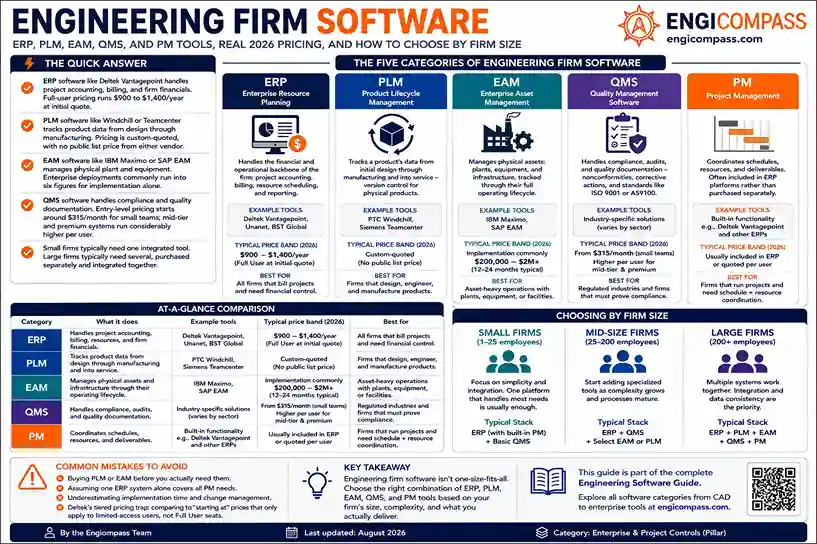
Engineering firm software covers five distinct categories. Most firms only need two or three of them, not all five. ERP handles project accounting and firm financials. PLM tracks product data through its full lifecycle. EAM manages physical assets like plants and equipment. QMS handles compliance and quality documentation. PM software coordinates schedules and resources. Which combination you need depends almost entirely on firm size and what you actually deliver.
Engineering firm software — the quick answer:
- ERP software like Deltek Vantagepoint handles project accounting, billing, and firm financials. Full-user pricing runs $900 to $1,400/year at initial quote.
- PLM software like Windchill or Teamcenter tracks product data from design through manufacturing. Pricing is custom-quoted, with no public list price from either vendor.
- EAM software like IBM Maximo or SAP EAM manages physical plant and equipment. Enterprise deployments commonly run into six figures for implementation alone.
- QMS software handles compliance and quality documentation. Entry-level pricing starts around $315/month for small teams; mid-tier and premium systems run considerably higher per user.
- Small firms typically need one integrated tool. Large firms typically need several, purchased separately and integrated together.
This guide is part of the complete engineering software guide, covering every category from CAD to enterprise tools.
By the Engicompass Team · Last updated: August 2026What does engineering firm software actually cover?
Five categories make up this space, and they solve genuinely different problems.
ERP (enterprise resource planning) handles the financial and operational backbone of a firm: project accounting, billing, resource scheduling, and reporting. For engineering and professional services firms specifically, Deltek Vantagepoint dominates this category, alongside competitors like Unanet and BST Global. Deltek doesn’t publish a fixed price list. Named sources show Full User subscription rates running $900 to $1,400/year at initial quote. That drops to roughly $680 to $1,080/year for negotiated multi-year commitments on larger deployments. Lower-cost limited-access tiers exist too. Timesheet-only or reporting-only users cost a fraction of a Full User seat. That’s why some pricing trackers quote a misleadingly low “starting at” figure that only applies to that limited tier, not to the seats most engineering staff actually need.
PLM (product lifecycle management) tracks a product’s data from initial design through manufacturing and into service — think of it as version control for physical products. Windchill (PTC) and Teamcenter (Siemens) lead this category. Neither publishes public pricing. Cost scales with user count and which modules you add, so expect a sales conversation rather than a price page.
EAM (enterprise asset management) manages physical assets: plants, equipment, and infrastructure, tracked through their full operating lifecycle. IBM Maximo and SAP EAM lead the enterprise tier. Full-scale deployments commonly run $200,000 to $2 million or more in implementation costs alone, with 12 to 24 months typical for a full rollout. Mid-market EAM tools exist at meaningfully lower cost, often quoted per-user per-month rather than as a massive fixed project.
QMS (quality management software) handles compliance, audits, and quality documentation — tracking nonconformities, managing corrective actions, and proving compliance with standards like ISO 9001 or AS9100. Pricing varies widely by industry and regulatory complexity. Entry-level QMS tools for small teams start around $315/month. Mid-tier and premium systems built for regulated industries like aerospace and life sciences run considerably higher, priced per user per month.
PM (project management) software coordinates schedules, resources, and deliverables. For engineering firms, this function often lives inside an ERP platform like Vantagepoint rather than as a separate purchase. The project accounting and the project scheduling are frequently the same underlying data.
Why do engineering firms need dedicated tools instead of generic business software?
This is the core reason engineering firm software exists as its own category, rather than teams just using whatever generic tool happens to be popular. Generic business software — a general accounting package, a general project management tool like Asana or Monday — doesn’t understand project-based billing the way engineering firms need it to. An engineering firm doesn’t sell a product at a fixed price. It bills for time, tracks utilization against a project budget, and manages multi-phase contracts where profitability depends on catching scope creep before it erodes margin.
Deltek Vantagepoint and its competitors exist specifically because generic ERP and generic project management tools don’t model that reality well. A generic tool tracks tasks and due dates. A purpose-built tool tracks billable hours against a project budget, flags a phase running over on utilization, and rolls that data straight into firm-wide financial reporting. That’s the actual question an engineering firm’s leadership needs answered, and generic software was never built to answer it.
The same logic applies to PLM and QMS. A generic file-sharing tool doesn’t track engineering change orders. It doesn’t maintain the audit trail a regulator expects during an AS9100 inspection either. Consider a real scenario: an aerospace supplier fails an audit because a design change never got logged with a timestamp and an approver’s name. A generic shared drive has no way to prevent that. A proper PLM or QMS system makes it structurally impossible to skip that step. The dedicated tools cost more because they’re solving a harder, more specific problem than generic software was built for.
At-a-glance: engineering firm software by category
| Category | What it does | Example tools | Typical price band | Best for |
|---|---|---|---|---|
| ERP | Project accounting, billing, firm financials | Deltek Vantagepoint | ~$900–$1,400/user/year (Full User) | Project-based engineering & AEC firms |
| PLM | Product data through design and manufacturing | Windchill, Teamcenter | Custom-quoted, no public price | Manufacturing & product design firms |
| EAM | Physical asset and equipment lifecycle | IBM Maximo, SAP EAM | $200K–$2M+ implementation (enterprise tier) | Asset-intensive operations (plants, utilities, infrastructure) |
| QMS | Compliance, audits, quality documentation | Industry-specific (aerospace, life sciences) | ~$315/month entry-level, higher per-user for premium tiers | Regulated manufacturing & aerospace/defense |
| PM | Scheduling and resource coordination | Often bundled into ERP | Included in ERP pricing above, for most engineering firms | Firms already running an ERP platform |
How do you choose engineering firm software by size?
Small firms (under 20 people) usually need exactly one integrated tool, not five separate systems. A small AEC or engineering consultancy typically starts with ERP alone. Deltek Vantagepoint or a lighter competitor covers this well, since project accounting and billing are the most urgent operational need. PLM, EAM, and QMS usually aren’t worth the cost until the firm reaches a scale where manual tracking genuinely breaks down.
Mid-size firms (20–200 people) typically add a second system once a specific pain point becomes undeniable. A manufacturing-adjacent firm scaling up product complexity adds PLM. A firm managing physical infrastructure adds EAM. A firm entering a regulated industry adds QMS. Add systems as real problems appear, not preemptively.
Large and enterprise firms (200+ people) often run three or more of these systems simultaneously, integrated together. At this scale, the cost of not having dedicated tools exceeds the licensing cost by a wide margin — billing errors, missed compliance audits, product data scattered across email threads all add up fast. Integration between systems becomes its own project, often requiring dedicated IT resources or a systems integrator.
The pattern that matters most: buy for the problem you actually have, not the scale you aspire to. A 15-person firm running full enterprise PLM alongside EAM and QMS is paying for capability it doesn’t need yet. A 300-person firm still running spreadsheets for project accounting is bleeding money in a different, more expensive way.
Common mistakes to avoid
Buying PLM or EAM before the firm actually needs it. These are enterprise-tier tools with enterprise-tier costs and implementation timelines. A small firm doesn’t need six-figure asset management software for a handful of pieces of equipment.
Assuming ERP alone covers project management needs. For many engineering firms it genuinely does, since Vantagepoint-class tools bundle scheduling with accounting. Confirm this before assuming a separate PM purchase is unnecessary — some firms do need dedicated PM software alongside ERP, particularly on complex multi-phase projects.
Underestimating implementation cost and timeline. The software license is rarely the biggest cost. EAM and PLM implementations at enterprise scale routinely take 12 months or more and cost multiples of the annual license in setup, migration, and training.
Trusting a low “starting at” price without checking which user tier it applies to. Deltek’s own pricing structure has multiple named-user tiers at very different price points. A “starting at $30/month” figure almost always refers to a limited-access tier, not the Full User rate most engineering staff actually need.
What’s next
The dedicated guides for each category are still being written. A deeper look at Deltek and Primavera alternatives with real pricing, requirements management tools for systems engineering, a full PLM software overview, enterprise asset management in depth, team collaboration and workflow tools, quality management systems, and cost estimation and bidding software are all coming. This page will link out to each one as it publishes. That’s how it becomes the real hub for this category, the same way the CAD & 3D Modeling guide does for that silo.
FAQ
What’s the difference between ERP and PLM? ERP manages the business side — project accounting, billing, resource scheduling. PLM manages the product side — a design’s data and revision history from concept through manufacturing. Many firms need both, purchased separately, since they solve genuinely different problems.
Do small engineering firms need PLM or EAM? Usually not right away. Small firms typically start with ERP alone and add PLM, EAM, or QMS only once a specific, concrete problem — not just growth in general — makes the case for it.
Why doesn’t Deltek publish pricing? Cost varies too much by user count, module selection, deployment model, and negotiated terms for a single list price to be meaningful. Expect a custom quote, and expect real negotiation room on multi-year, larger-seat-count deals.
What does QMS software actually track? Nonconformities, corrective actions, audit documentation, and compliance against a standard like ISO 9001 or AS9100. It exists to prove — with a documented trail — that a firm’s quality processes actually work, not just to store paperwork.
How long does an EAM or PLM implementation actually take? Enterprise-scale implementations commonly run 12 to 24 months, not weeks. Budget for that timeline explicitly rather than assuming a new system solves problems within the first quarter after purchase.
Can one platform cover more than one of these five categories? Sometimes, at the edges. Deltek Vantagepoint bundles ERP with project management for most engineering firms, and some enterprise suites bundle PLM with basic quality tracking. But no single platform genuinely covers all five well — a vendor claiming to do everything is usually strong at one category and thin everywhere else.
Is it worth switching ERP systems once a firm has outgrown a generic tool? Usually yes, and sooner than most firms actually make the move. The cost of switching is real — data migration, retraining, a few months of reduced productivity — but it’s a one-time cost. The cost of staying on a generic tool that doesn’t model project-based billing correctly compounds every single billing cycle.