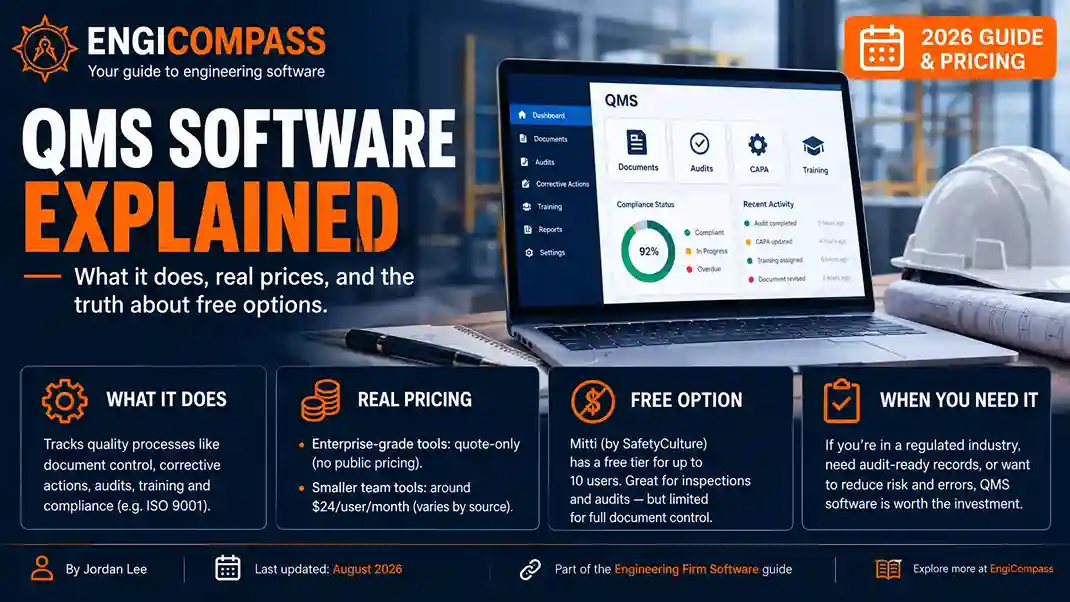
Search for QMS software and every result promises the same thing: fewer errors, happier customers, easy compliance. Almost none of them say what it costs. This guide does. It covers what QMS software actually does, real prices where they exist, and an honest look at the free options — including where they fall short of what the word “free” might lead you to expect. QMS is also covered as part of the broader engineering firm software guide.
QMS software — the quick answer:
- QMS stands for quality management system. It’s software that tracks how well a company follows its own quality rules — document control, corrective actions, audits, and proof that standards like ISO 9001 are actually being followed.
- Most dedicated engineering-grade QMS tools are quote-only. Real prices are hard to find without talking to sales.
- Mitti (by SafetyCulture) has a genuine free tier for up to 10 users. It leans more toward inspections and audits than full document-control QMS, so check that it actually fits before counting on it.
- Paid QMS tools built for small teams do publish real prices, though sources don’t always agree on the structure. One source puts a real example around $24/user/month; another shows a flat unlimited-user rate for the same tool. Either way, expect annual billing for the advertised rate, and add-ons like training content to cost extra.
What does QMS software actually do?
QMS stands for quality management system. In plain terms, it’s the tool a company uses to prove it’s actually doing what it says it does. That includes document control (the right version of a work instruction, in the right hands), corrective and preventive action (fixing a problem and stopping it from happening again), audits, and training records. The point is proof, not just good intentions — a real, checkable record that quality rules were followed.
ISO 9001 is the standard most QMS software is built around, though it’s far from the only one. Aerospace has its own layer, and it’s worth knowing the name is changing right now: AS9100 is actively transitioning to a new name, IA9100, with certified organizations given a real transition window before the old AS9100 certification stops being recognized. Medical devices have their own layer too (ISO 13485, FDA 21 CFR Part 820). Automotive has IATF 16949. Most QMS tools support several of these standards at once, since a company making aerospace parts, for example, usually needs to satisfy more than one regulator.
QMS often works alongside PLM, not instead of it. A design change in your PLM system and a corrective action in your QMS are frequently the same real-world event, just viewed from two different angles. See the PLM software guide for how that connection typically works, and the engineering data management guide for the design-file side of the same picture.
What does QMS software actually cost?
Most dedicated, engineering-grade QMS platforms are quote-only. Tools built for manufacturers and regulated industries — the kind that plug into PLM systems and handle real document control at scale — mostly ask you to talk to sales before you see a number. Cost depends on user count, which modules you need, and which regulatory standards you’re tracking.
Tools aimed at smaller teams tend to publish real prices, and it’s worth checking more than one source. They don’t always agree. Mitti’s Premium plan is a real, useful example of why: one source lists it at roughly $24 per user per month billed annually, while another independent source shows a flat unlimited-user rate instead. That’s a real, unresolved difference between sources, not something this guide can cleanly settle — confirm the current structure directly before assuming either number applies to you.
Read past the headline price before committing, on whichever structure ends up applying to you. A detailed, sourced breakdown of Mitti’s per-user pricing found that the advertised rate requires annual billing paid upfront. Training content — often the actual reason a small team wants this kind of tool — is licensed as a separate add-on. Under that per-user structure specifically, a 25-person team on the annual plan can mean $7,200 due at signing, before extras. That’s not unique to one vendor. It’s a common pattern worth checking for in any QMS quote, regardless of which specific pricing model you end up facing.
The free QMS software option, and its real limits
Mitti (by SafetyCulture) has a genuine free tier, capped at 10 users. It’s real and usable, not a crippled trial — confirmed independently across multiple review platforms. Worth knowing the name is brand new: SafetyCulture rebranded to Mitti in August 2026, and the company itself still uses both names together during this transition, so don’t be surprised to see “SafetyCulture” in older reviews or even in your own account.
Here’s the honest part most guides skip: Mitti is built primarily for inspections, audits, and checklists, not full document-controlled QMS. If what you actually need is formal revision-controlled document management tied to a design-change process, Mitti’s free tier is a genuinely different tool than that, even though it markets itself under the QMS label. It’s a strong fit for safety walkthroughs, audit tracking, and compliance checklists. It’s a weaker fit, though, if formal document control tied to engineering changes is the real requirement.
When do you actually need dedicated QMS software?
A shared drive with a real document-control process can cover early-stage or low-risk work. If you’re not yet answering to an external auditor or a regulator, a careful manual process is a legitimate starting point, not a placeholder.
Formal QMS software earns its cost once an external party needs to see proof, not just your word. ISO certification audits, customer quality audits, and regulatory inspections all want a real, checkable record. Timestamps, approvals, and a genuine audit trail are things a spreadsheet can’t reliably produce.
Multiple sites or a growing team is a second real signal. Keeping quality records consistent across locations is one version of this. So is a team that’s outgrown one person’s memory of “how we do things” — exactly the kind of problem dedicated QMS software is built to solve.
Common mistakes to avoid
Assuming a free inspection tool covers the same ground as a document-controlled QMS. Mitti’s free tier is real, but check whether your actual need is inspections and checklists, or formal revision-controlled document management — they’re genuinely different jobs.
Budgeting from the advertised per-user price without checking for annual-billing requirements or add-on costs. Training content, onboarding fees, and the gap between monthly and annual pricing are real, common extras that can push the real cost well past the headline number.
Buying full QMS software before checking what your target certification actually requires. ISO 9001, AS9100 (currently transitioning to IA9100), and industry-specific standards each have different real documentation demands. Confirm what your specific certification needs before assuming you need every module a vendor offers.
Treating QMS and PLM as competing purchases instead of connected ones. They typically work together, tracking the same real product from two different angles. Buying one without a plan for how it connects to the other is a common, avoidable gap.
FAQ
What does QMS actually stand for? Quality management system. It’s software built to prove — with a real, checkable record — that a company is following its own quality processes, not just claiming to.
Is there really a free QMS option, or is it always paid? There’s a real free option in Mitti (by SafetyCulture), capped at 10 users. The honest caveat: it’s built more for inspections and audits than full document-controlled QMS, so confirm it actually matches your real need before counting on it.
Why don’t most QMS vendors publish their prices? Most engineering-grade platforms don’t, and neither has stated a specific reason — it’s common practice across enterprise software generally. A direct quote is usually the only reliable way to know your real price.
Do I need QMS software if I’m a small team not yet facing an audit? Often not yet. A careful manual process, real document version control, and consistent record-keeping can cover early-stage work. QMS software tends to earn its cost once an external auditor, regulator, or customer needs to see real, checkable proof.
How does QMS relate to ISO 9001 specifically? ISO 9001 is the general-purpose standard most QMS software is built around, though it’s not the only one — aerospace, medical device, and automotive industries each layer their own additional standards on top. Worth knowing if aerospace applies to you: AS9100 is actively transitioning to a new name, IA9100, right now. Most dedicated QMS tools support several standards at once for exactly this reason.